Grok Bot as a Diagram
One job per bot, a shared computer, and a human gate on anything irreversible, drawn the way I explain agent systems.
How it works
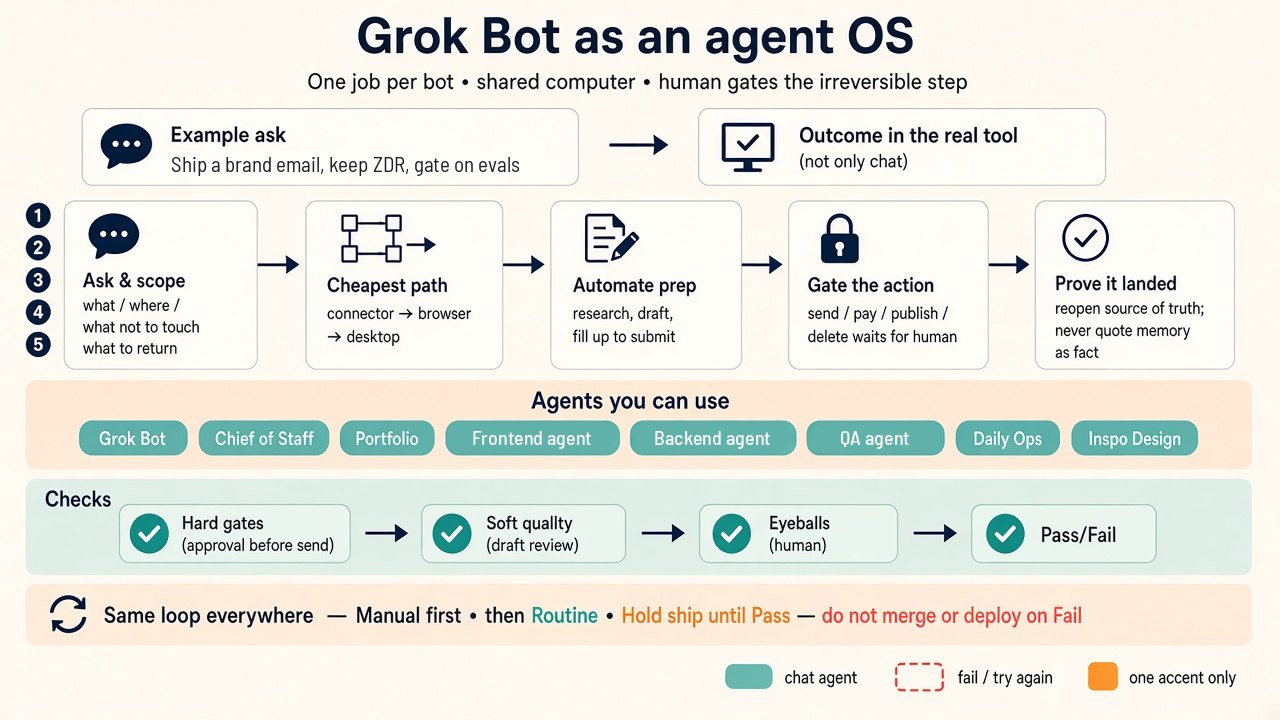
Caption: Same loop as my Clear diagram / GOLD habit: agents you can chat, checks that matter, hold ship until Pass.
What the boxes mean
Ask & scope. Every task names what, where the data lives, what not to touch, and what to return. Vague "just handle it" is a defect.
Cheapest path. Connector before browser. Browser before desktop. The computer is for sites with no API and for a sign-in only the human can finish.
Automate prep. Research, sort, draft, fill the form up to submit. Prep is free.
Gate the action. Send, pay, publish, delete, change production: wait for approval. You cannot undo those after.
Prove it landed. Reopen the source of truth. Never quote memory as fact for amounts, statuses, or names that change.
Agents you can use
The teal pills are real sidebar roles, not a 50-bot org chart: Grok Bot routes; Chief of Staff owns cadence; Portfolio owns the site; work-app specialists own frontend / backend / QA; Daily Ops remembers what you did; Inspo Design runs the inspiration → SPEC → build loop.
One owner per task. Handoff when the role, tools, or schedule differ, not because the ask is long.
My take
A chat answers and stops. A bot has a job, memory, and a computer that stays signed in. That difference is the whole product.
I keep drawing it the same way I draw eval loops for work apps: flat cards, teal agent pills, hard gates before send. The diagram is the operating system.
Same loop everywhere
Manual first with safe inputs. Confirm missing data is reported, not invented. Only then save a routine. A routine prompt is intent, not a frozen tool recipe.
Hold ship until Pass. Do not merge or deploy on Fail.
Why draw it
Memory and context engineering get talked about as magic. The diagram is the opposite: durable facts live in memory; changing facts get reopened; irreversible steps stay gated. That is how I run Grok Bot day to day, and how I want the Writing here to read: systems you can operate, not slogans.
Try this
- Pick one task you hand an agent and write its ask and scope: what, where the data lives, what not to touch, and what to return.
- List the steps in it you can't undo (send, pay, publish, delete) and put each one behind an approval.